
Robert Voloder scouting breakdown
Assessing Robert Voloder’s defensive values and limitations

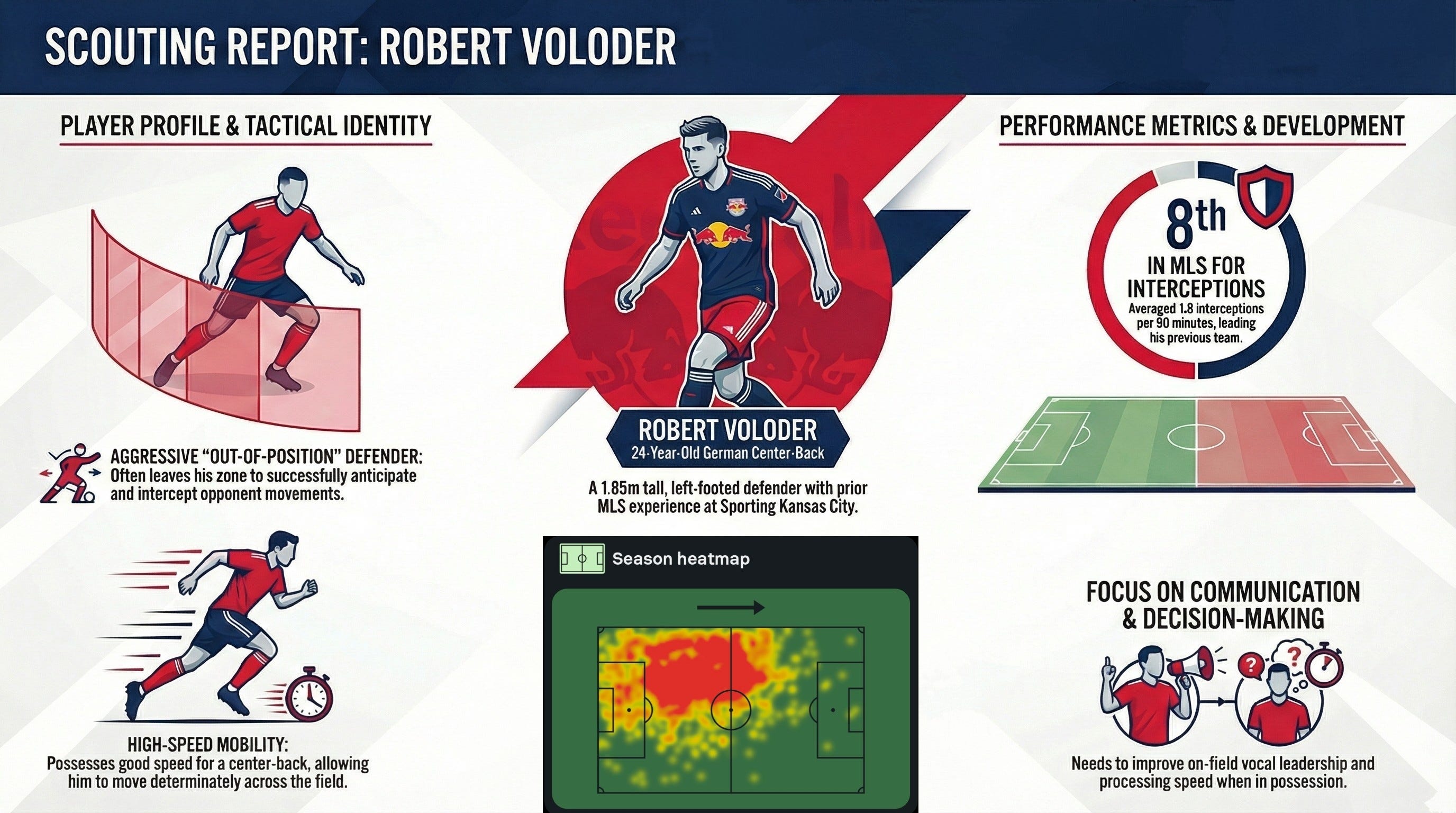
On January 12th the free agent Robert Voloder signed with the New York Red Bulls, a centerback who spent the past four seasons with the Sporting Kansas City, playing in a total of 61 games.
During his time in Kansas City, Voloder established himself as a reliable squad option, gaining experience. His MLS background and familiarity with the league’s demands make him an acquisition with a certain assurance of efficiency, particularly for a Red Bulls side looking to reinforce depth and solidity along the back line.
Out of possession: Anticipation and physical reliability
Voloder shows very little hesitation in leaving his zone to anticipate the opponent, an approach he executes with consistency and confidence. He reads passing lanes well and is proactive in stepping forward to try to disrupt offensive phases before they fully develop, rather than relying purely on reactive defending.
He combines this anticipation with good body control in duels, allowing him to remain coordinated when engaging attackers, and to be in a good position when needed to recover after stepping out of line.
Voloder is, without doubt, a strong and reliable tackler, capable of winning the ball cleanly without excessive fouling.
His defensive impact is reflected in his numbers: last season he led his team in interceptions, averaging 1.8 per 90 minutes. Among center backs with at least 800 minutes played, this placed him 8th across the entire league, underlining both the volume and consistency of his defensive interventions.
In possession: Short-range circulation and contribution
One of the main aspects limiting Voloder’s overall performances is his communication on the field. He is a smart defender with decent positioning skills and a good ability to read and track opponents’ movements, but these qualities alone are not sufficient when operating within, and especially when managing, a defensive line.
Communication is what allows individual defensive actions to become collective stability, and this is an area where Voloder still has room to grow.
Without consistent communication, even correct defensive reads can create moments of structural imbalance. The same applies in possession: his uncertainty on the ball and preference for long passes are sometimes the consequence of passing options that are not clearly organized and called for, resulting in a drop with his confidence and decision-making speed. This shortcoming impacts both his defensive and offensive contribution.
To reach the next level in his role, Voloder needs to be more vocally involved, to contribute in defining the team’s spacing.
In a well-drilled system, improved communication would allow his anticipation, tackling ability, and composure when stepping forward to be expressed more consistently and with fewer risks.
When surrounded by close support and provided with simple, reliable passing options, Voloder can circulate possession effectively and even step into midfield to disrupt the opponent’s defensive shape. However, when asked to progress the ball through riskier or more autonomous decisions, his effectiveness drops, reinforcing the need for a possession structure that emphasizes short combinations.
At the moment he struggles with his decision-making, both in terms of processing time and execution, when pressed or required to make quick choices his confidence on the ball decreases, leading to conservative or rushed solutions.
The high number of attempted long balls registered in the last season is therefore not a coincidence, but a clear symptom of this uncertainty.
While Voloder is technically capable of executing long passes, his statistics reflect the inconsistency of these actions, with 3.3 misplaced long balls per 90 minutes. In contrast, he led his team in completed short passes, averaging 47.2 per 90 minutes, highlighting a profile that is far more comfortable operating within shorter, clearly defined passing structures. This contrast underlines the importance of context in evaluating his on-ball contribution.
He is certainly not a centerback who likes to manage possession, you won’t see him playing many direct passes with joy, and that’s why it’s important to build a short-passes system around him. The purpose of this adjustment should not be focused on making Voloder something he isn’t, but rather on increasing the times in which he can show his composure when moving out of position.
Athletic profile: Speed without explosiveness
Looking at his athletic profile, Voloder is not an explosive defender, and he can encounter difficulties when dealing with tight spaces or sudden changes of direction. His first-step acceleration and agility in short, reactive movements are not standout qualities, particularly when isolated against quick, dynamic attackers.
However, he compensates for this with good straight-line speed for a center back. Once in motion, Voloder is capable of covering ground effectively, allowing him to track runners, and recover position after stepping forward. This makes him more comfortable defending over distance rather than in sharp, stop-start situations.
In this off-season the team sold both Sean Nealis to D.C. United, and the signing of Voloder is directly connected to that operation. In addition to the basic fact that the New York Red Bulls needed depth, Voloder will be essential in filling the gap left by Nealis. After the time that a defensive line needs to work properly, there is no doubt on Voloder’s capability to replace Nealis, who is also four years older than the German centerback.
Overall a very good and much needed signing, clearly an operation made with logic.
Very nice analysis. Keep it up!
Hope Voloder works out. Lots of questions along the back line right now.